




Artificial Intelligence: How Does It Affect Home Appliances?
Artificial intelligence in the home is becoming an integral part of our daily lives, changing the definition of how we interact with technology. Have you ever wondered how your refrigerator knows when to buy groceries? Or how your washing machine can automatically choose the optimal wash cycle? In this article, we will look at the importance of artificial intelligence in home appliances, its capabilities, benefits, challenges and future prospects.
Definition and principles of operation of artificial intelligence in everyday life
What is artificial intelligence?
Artificial intelligence (AI) is a branch of computer science that deals with creating systems that can perform tasks that require intelligence, such as speech recognition, image processing, or decision-making. In home appliances, AI algorithms analyze large amounts of data to improve the efficiency and usability of devices. This allows for smarter and more adaptive solutions for home use.
Basic technologies and algorithms of artificial intelligence in everyday life
Artificial intelligence in home appliances uses several basic technologies that ensure its operation:
- Machine learning — algorithms that adapt to users' needs based on their behavior and habits.
- Computer vision — technologies that allow devices to recognize objects and their characteristics, for example, in security systems.
- Natural Language Processing — the ability of the system to interact with users through language, which improves the user experience.
- Big data analysis — methods that allow you to extract useful information from huge amounts of data, helping devices understand user needs.
The impact of artificial intelligence on home appliances
Smart home devices
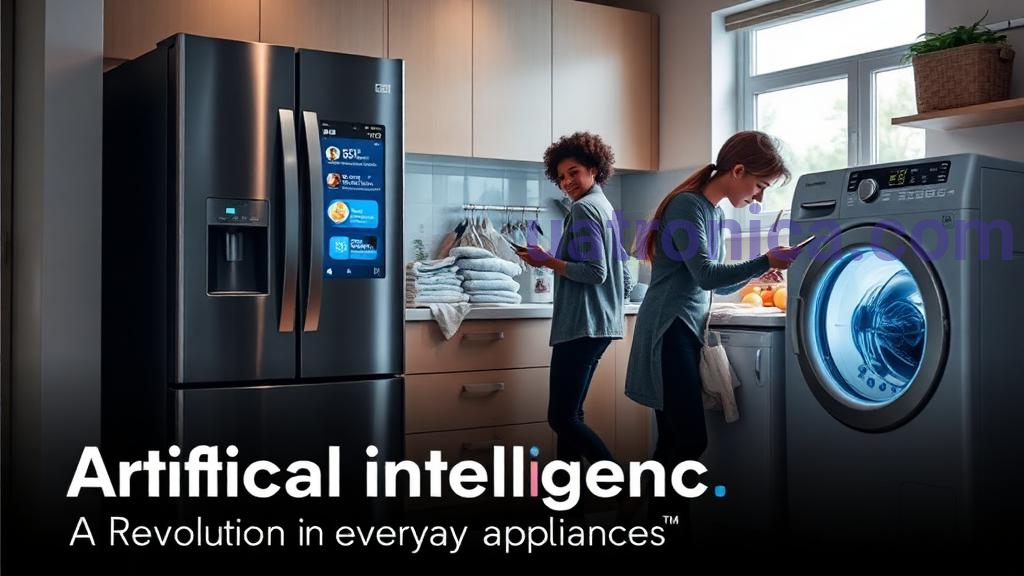
There are many smart devices on the market today that make everyday tasks much easier. For example:
| Device type | Function | Advantages |
|---|---|---|
| Smart refrigerator | Product end of life notifications | Preventing food spoilage, saving money |
| Washing machine | Automatic wash cycle selection | Saving water and electricity |
| Smart lighting | Adaptation to user activity | Convenience and energy saving |
These devices use artificial intelligence to analyze data, allowing them to perform functions with maximum user comfort. They not only make our lives easier, but also much more efficient.
Automation and control
Automation is one of the biggest advancements that the integration of artificial intelligence into home appliances has led to. The Internet of Things (IoT) plays a major role in enabling communication between various devices in the home.
With IoT, different devices can communicate with each other and perform tasks automatically. For example, if your washing machine has finished washing, it can notify your smartwatch so that you don’t miss the moment it’s finished. This is not only more convenient, but also saves electricity and resources.
Advantages of using artificial intelligence in everyday life
Saving time and effort
Using artificial intelligence in home appliances can save you a lot of time. Automated tidying or reminders for important purchases simplify everyday tasks. This frees up time for other important things in life, such as spending time with loved ones or relaxing.
Improving efficiency and energy saving
Smart devices use algorithms that help optimize resource consumption. An example would be smart washing machine, which automatically adjusts the water volume depending on the load. This significantly reduces costs, allowing users to not only save money but also protect the environment.

Challenges and dangers
Security and privacy issues
However, the use of artificial intelligence does not come without certain risks. One of them is the issue of security and protection of personal data. For example, smart devices can collect information about the user’s habits, which puts privacy at risk. Measures must be taken to protect personal data when such innovative technologies are used. A deeper understanding of these risks can be found in this article on data security.
Ethical issues and impact on workplaces
Ethical issues are also an important aspect of the implementation of artificial intelligence. In particular, automation may lead to job losses in traditional sectors, increasing the need to retrain workers and adapt to new labor market conditions. This is why it is important to support training and education programs for those who may be at risk.
The future of artificial intelligence in home appliances
Development trends and innovations
The future of AI in home appliances promises to be dynamic. As technology advances, new innovations are expected to further enhance the convenience and efficiency of home appliances. From increasing autonomy to improving interfaces that are more understandable to users, these changes have the potential to significantly change our experience.
A look at the next few years: what to expect?
In the next few years, we will likely see the growing integration of artificial intelligence into all aspects of our lives. Technologies that now seem fantastic could become reality, and controlling our homes through voice commands or even thoughts could become commonplace. Companies will continue to invest in research and development to create new, even smarter solutions.
It should be noted that the electronic components market is on a rising wave of demand due to technological developments, so it is important to follow the latest news to stay up to date with new products such as interesting chips from the Internet of Things. Among the new products that may interest technical specialists and enthusiasts are, for example, module SA36-11SRWA-KGB, which is ideal for creating your own AI-based projects. Or resistor CR0805-FX-1000ELF, a powerful element for household appliances.
Artificial intelligence in everyday life opens up new horizons for technological innovation. We can only watch this exciting development and be ready to make changes in our daily lives. We invite you to share your thoughts and analyze the impact of artificial intelligence on everyday aspects of life with us.